
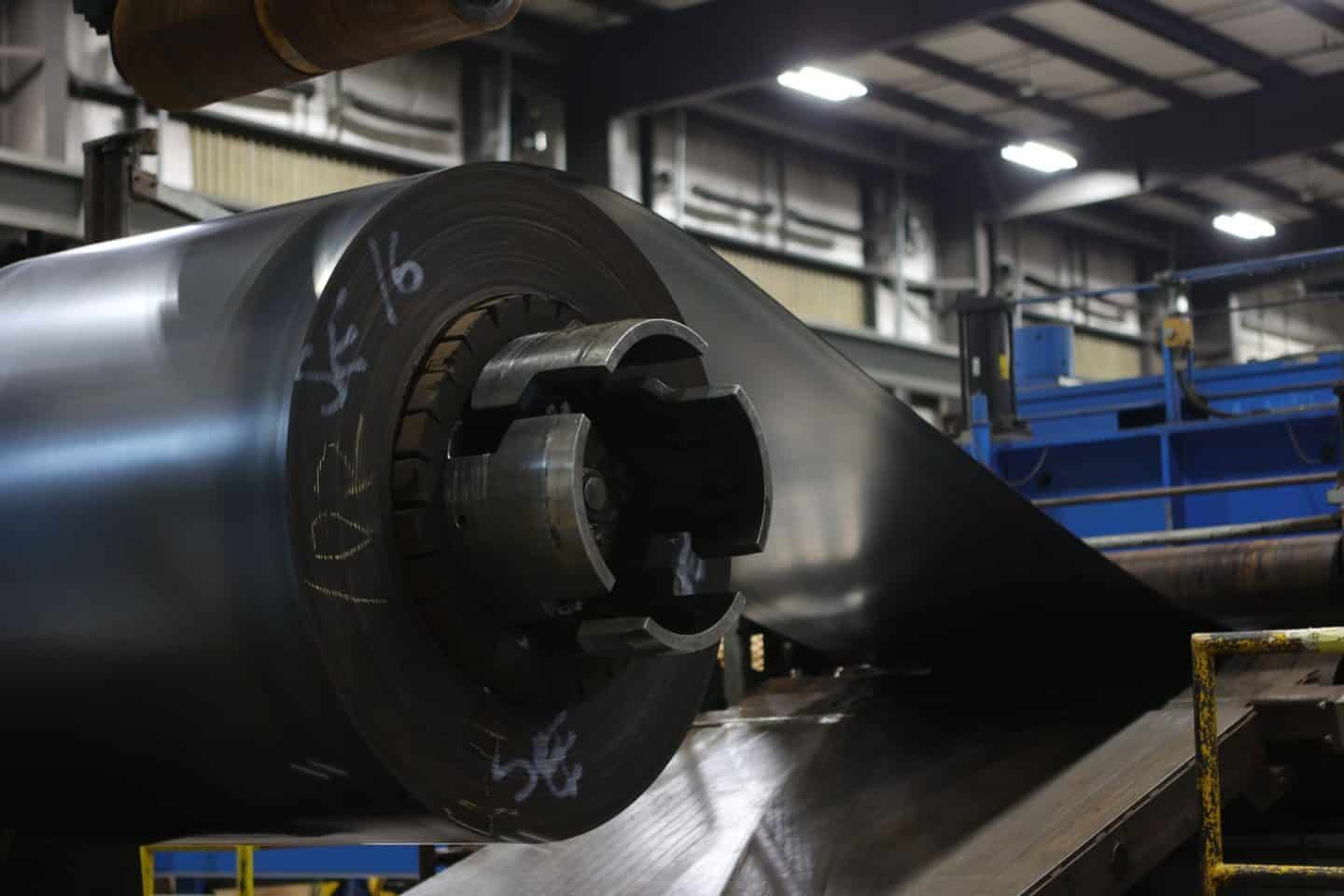
What Is Hot-Rolled Steel?
Hot-rolled steel is processed at elevated temperatures above the steel’s recrystallization temperature.
Rolling at high temperatures makes the steel easier to form and allows it to be produced efficiently in a wide range of thicknesses and dimensions.
As the steel cools, dimensional changes can occur, resulting in generally wider tolerances than cold-rolled products. The surface also typically develops a layer of iron oxide known as mill scale, giving conventional hot-rolled steel its characteristic industrial appearance.
Hot-rolled steel is commonly selected for applications where strength, cost and general fabrication requirements are more important than a smooth surface finish or particularly tight dimensional tolerances.
Common applications include:
- Structural components
- General fabrication
- Heavy equipment
- Industrial manufacturing
- Welded components
- Applications where a smooth surface finish is not required
Hot-rolled steel is available in a variety of grades and thicknesses, with mechanical properties determined by the specified grade and manufacturing process.
What Is Cold-Rolled Steel?
Cold-rolled steel undergoes additional processing after hot rolling.
The material is typically cleaned to remove mill scale and then rolled at or near room temperature to reduce its thickness and achieve tighter dimensional tolerances and a smoother, more uniform surface.
Cold rolling can increase the steel’s strength and hardness through work hardening. However, many cold-rolled products undergo additional heat treatment, known as annealing, to restore ductility and achieve specific mechanical properties.
As a result, cold-rolled steel is not necessarily stronger than hot-rolled steel in every application. Its final properties depend on the grade, degree of cold reduction and subsequent processing.
Cold-rolled steel is commonly selected for applications where dimensional consistency, surface quality and forming characteristics are important.
Common applications include:
- Appliances
- Cabinets and enclosures
- Furniture
- Manufactured components
- Precision fabrication
- Applications where surface quality and appearance are important
Cold-rolled steel is particularly useful for products that require consistent dimensions, a cleaner surface or additional finishing processes such as painting and coating.
What Is HRPO Steel?
HRPO stands for Hot-Rolled Pickled and Oiled steel.
HRPO begins as hot-rolled steel but undergoes additional surface treatment to remove the mill scale formed during the hot-rolling process.
The steel is passed through a pickling process, typically using an acid solution to remove surface oxides. A thin layer of oil is then applied to help provide temporary protection against rust during handling, storage and transportation.
This process produces a cleaner, scale-free surface while retaining the general dimensional and mechanical characteristics of the specified hot-rolled material.
HRPO does not undergo the additional cold-reduction process used to manufacture cold-rolled steel and therefore does not automatically provide the same tight dimensional tolerances or surface characteristics.
Common applications include:
- General fabrication
- Automotive and manufactured components
- Laser cutting and metal processing
- Welded assemblies
- Formed components
- Applications requiring a cleaner surface than conventional hot-rolled steel
HRPO can be a practical alternative when a cleaner surface is required but the tighter tolerances of cold-rolled steel are not necessary.
The protective oil is temporary and should not be considered a permanent corrosion-resistant coating. Appropriate surface preparation may be required before painting or other finishing processes.
Hot-Rolled vs. HRPO vs. Cold-Rolled Steel
| Property | Hot-Rolled Steel | HRPO Steel | Cold-Rolled Steel |
|---|---|---|---|
| Processing | Rolled at elevated temperatures | Hot-rolled, then pickled and oiled | Further rolled at or near room temperature |
| Surface finish | Mill scale typically present | Cleaned, scale-free surface | Smoother and more uniform |
| Dimensional tolerances | Generally wider | Generally similar to hot-rolled | Generally tighter |
| Strength and hardness | Grade dependent | Generally similar to corresponding hot-rolled grade | Dependent on cold reduction and annealing |
| Surface preparation | Mill scale removal may be required | Oil removal and preparation may be required | Cleaning and preparation may be required |
| Relative cost | Generally lower | Moderate | Generally higher |
| Typical applications | Structural and general fabrication | Fabrication and manufactured components | Precision and appearance-sensitive applications |
Note: Characteristics are general comparisons. Actual tolerances, surface quality, mechanical properties and availability depend on the material grade, thickness, product specification and supplier.
Which Should You Choose?
The choice between hot-rolled, HRPO and cold-rolled steel depends on the application’s dimensional, surface, fabrication and performance requirements.
Hot-rolled steel is often preferred for structural applications, heavier gauges and general fabrication where cost and material availability are important considerations. It is well suited for projects where the surface finish and dimensional tolerances of conventional hot-rolled material are acceptable.
HRPO steel is a practical option when a cleaner, scale-free surface is desired without the additional cold-reduction process. It is commonly selected for fabrication, cutting, welding and manufactured components where conventional hot-rolled tolerances are sufficient.
Cold-rolled steel is generally preferred for applications requiring tighter dimensional tolerances, a smoother surface or consistent appearance. It is frequently used in appliances, furniture, enclosures and precision-manufactured components.
Other factors should also be considered, including steel grade, thickness, mechanical properties, forming requirements, welding, surface preparation, downstream processing and cost.
In short: Hot-rolled steel offers an economical solution for many structural and general fabrication applications. HRPO provides the benefits of hot-rolled steel with a cleaner, scale-free surface, while cold-rolled steel offers tighter dimensional tolerances and a more uniform finish for applications where precision and appearance are important.
Always review the applicable material specifications and project requirements before making a final selection.