
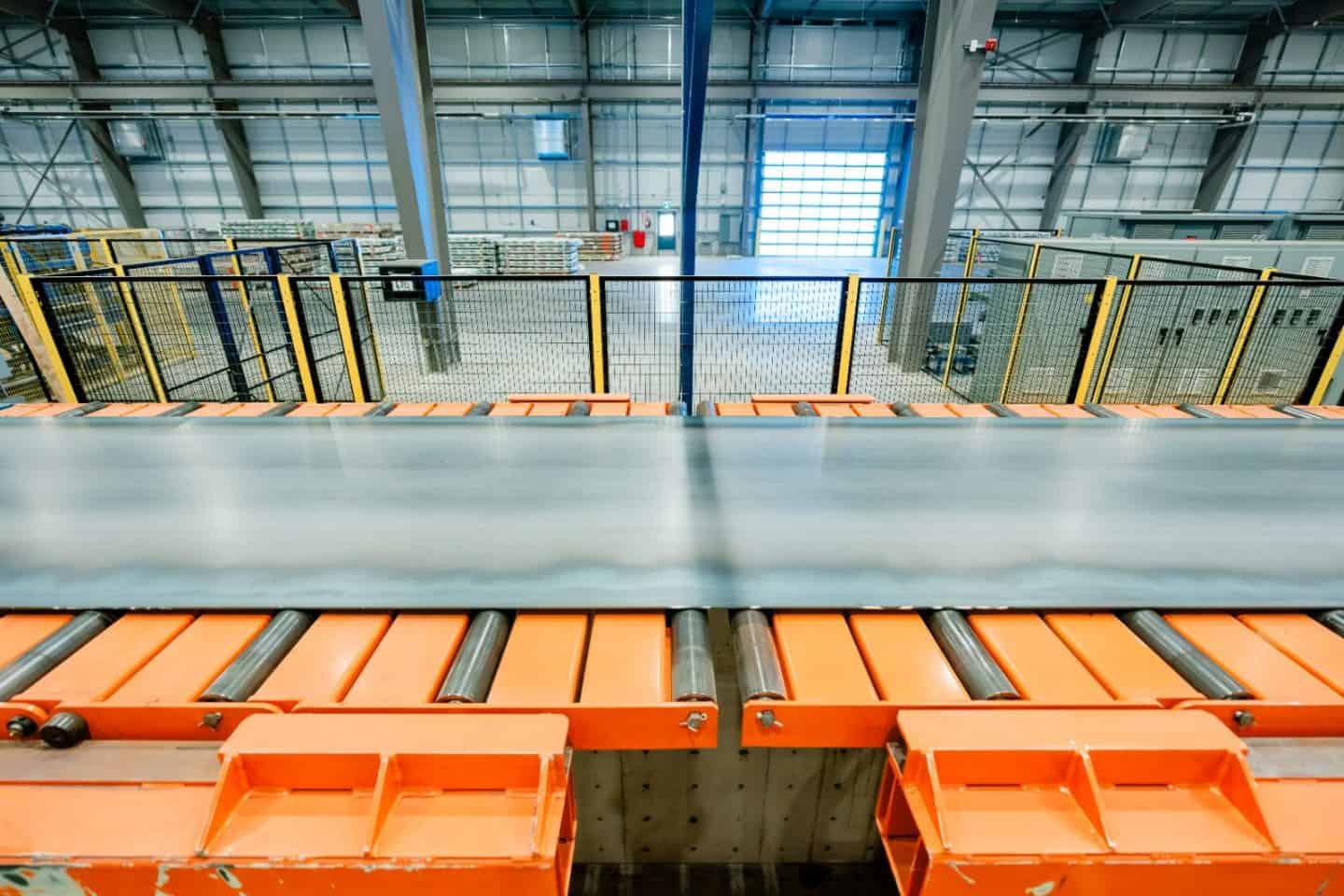
This is where stretch leveling can provide an advantage.
What Is Stretch Leveling?
Stretch leveling is a coil processing method designed to produce exceptionally flat sheet while reducing internal stresses within the material.
During the process, the material is leveled and stretched beyond its yield point in a controlled manner. This helps address shape defects and residual stresses that can remain in coiled material.
The result is flat, stable sheet that can perform more consistently during downstream processing and fabrication.
When Should Stretch-Leveled Material Be Considered?
Stretch leveling can be particularly valuable when flatness is critical to the finished application or subsequent manufacturing process.
Common situations include:
- 01
Laser Cutting
Flatter, more stable sheet can improve material handling and consistency during laser cutting, particularly on larger components.
- 02
Plasma Cutting
Improved flatness can help material sit more consistently on the cutting table and reduce issues associated with uneven sheet.
- 03
Forming and Fabrication
Reducing residual stresses can help improve consistency when material is subsequently cut, formed or fabricated.
- 04
Large or Long Components
Flatness becomes increasingly noticeable as part dimensions increase. Applications involving large panels or long components may benefit from stretch-leveled material.
- 05
High-Strength Materials
Higher-strength steels can present additional flatness and residual-stress challenges. Stretch leveling can help produce more stable sheet for downstream processing.
Stretch Leveling vs. Standard Cut-to-Length
Both processes convert coil into sheet, but they serve different requirements.
Standard cut-to-length
Standard cut-to-length processing levels the material and cuts it to a specified length. For many applications, this provides the flatness required.
Stretch leveling
Stretch leveling goes further by applying controlled tension to the material to improve flatness and reduce internal stresses.
The appropriate process depends on the material and how the sheet will ultimately be used.
Why Does Residual Stress Matter?
Residual stresses can remain in steel after rolling, coiling and other manufacturing processes. When material containing these stresses is cut, particularly into complex or narrow shapes, those stresses can redistribute.
This can contribute to the material moving, twisting or changing shape after cutting.
Reducing residual stresses before fabrication can therefore provide more predictable material behaviour and help improve consistency throughout downstream operations.
Do You Need Stretch Leveling?
Not every application requires stretch-leveled sheet. For many projects, conventional leveled sheet is entirely appropriate.
Stretch leveling becomes worth considering when your application places a greater emphasis on flatness, stability, cutting performance or dimensional consistency.
Material grade, thickness, sheet dimensions and downstream processing should all be considered when determining whether stretch leveling is appropriate.